
Fields in Chatham Property Tax Records
Two offices divide the work in Chatham County. The Board of Assessors sets fair market value, taxable assessed value, and exemption treatment. The Tax Commissioner then applies millage rates and issues the bill. The office also takes payment and pursues delinquent accounts. Recorded deeds stay with the Superior Court Clerk instead. So a single property records search can pull from three custodians at once.
Always read the tax district and parcel details beside the totals. Two neighboring parcels can carry very different tax bills. The cause may be jurisdiction, exemptions, improvements, classification, or appeal history. A total alone never reveals which. Keep the notice and the bill from the same year together. Compare each labeled field before concluding anything.
| Field | What It Shows | Where |
|---|---|---|
| Fair market value | Assessor's value judgment for the year | Notice and roll |
| Taxable assessed value | Value after Georgia assessment rules | Notice and tax data |
| Exemptions or credits | Approved reductions or preferences | Assessment notice |
| Millage and levy | Rates applied by taxing authorities | Tax bill |
| Balance and payment | Amount billed, paid, or delinquent | Tax Commissioner |
The parcel number ties assessment and bill together. Enter it exactly. Names and mailing addresses change over time, so a parcel number is the safer key for any property records search. Never compare values across years without labeling the year for each figure.
Ask the right office, too. The Board of Assessors handles characteristics, fair market value, exemptions, and appeals, while the Tax Commissioner covers billing, payment, delinquency, sales, and excess funds. Deed corrections belong to the Superior Court Clerk. A request sent to the wrong custodian tends to return an answer built on records that office never controlled.
Georgia's Chatham Assessment Level
Georgia law sets a standard assessment level. The Georgia Department of Revenue explains the standard. Most property is assessed at 40 percent of fair market value. The county assessor estimates that market value under state tax rules. Assessed value then applies the statutory fraction. Approved exemptions can then reduce taxable value before millage rates produce the final tax bill.
Keep the numbers labeled. A recorded sale is one market event, not an appraisal. A bill is a tax calculation, not a sale estimate. Read each figure under its own name.
- Fair market value
- The assessor's full-value estimate for the assessment date.
- Assessed value
- The value after Georgia's assessment level is applied.
- Millage
- A rate stated per thousand dollars of taxable assessed value.
- Homestead exemption
- An approved benefit that can reduce taxable value for a qualifying home.
- Tax lien
- A legal claim tied to unpaid tax, distinct from a routine bill.
Chatham's New Assessment Notice Fields
The Board of Assessors has redesigned its 2026 notice. It now lists fair market value and taxable assessed value. The notice also shows exemptions or credits, preferential assessment, and estimated tax savings. Owners are directed to Property Records Search and the Annual Assessment Notice tab.
Value History may show an APPEAL DECISION with a 299C freeze. The Board also cautions about a home bought in December 2025. That home can be assessed above its purchase price under the HB581 and HB92 circumstances it describes. Those current-year rules deserve a recheck on the live notice.
Remember that the notice is an assessment record, not the bill. Check the parcel facts and value reason first. A change can flow from a sale review. It can also come from a revaluation, corrected characteristics, an appeal decision, or exemption treatment. County annual reports add broad context. But the parcel notice and appeal file govern the individual property records.
Find a Chatham County Tax Bill
The Chatham Tax FAQ lists three ways to search: property ID, address, or name. Property ID is the strongest key. Addresses work best in the situs form, and street variants sometimes help. A name search should include entity names and co-owners. Keep the bill year in view. Its owner of record may differ from a later deed. Save the query date and the downloaded tax bill. That way a portal change cannot erase the basis for comparison.
- Search the Chatham Tax property portal by exact PIN, situs address, or owner name.
- Match address and parcel before selecting the assessment or bill year.
- Read market value, assessed value, exemptions, rate, balance, and payment separately.
- Save the bill and compare its owner date with the latest deed after a sale.
- Check delinquency, recorded liens, and the current Tax Sale List when relevant.
- Situs address
- The physical parcel location used for map and permit matching.
- Mailing address
- The tax-notice destination, which does not prove occupancy.
- Property ID
- The county tax and map key.
- Tax year
- The year to which the bill, owner snapshot, and rates apply.
The Chatham January 1 Owner Rule
The Tax Commissioner FAQ explains the rule. The tax bill follows whoever owned the parcel on January 1. So a mid-year buyer may still see the former owner of record on that year's bill, even after the new deed records. Chatham publishes no fixed assessor refresh schedule. For a recent transfer, compare the deed recording date, the assessment year, and the bill year. Do that before assuming a name mismatch is an error. View the Chatham Tax screen to start a search.
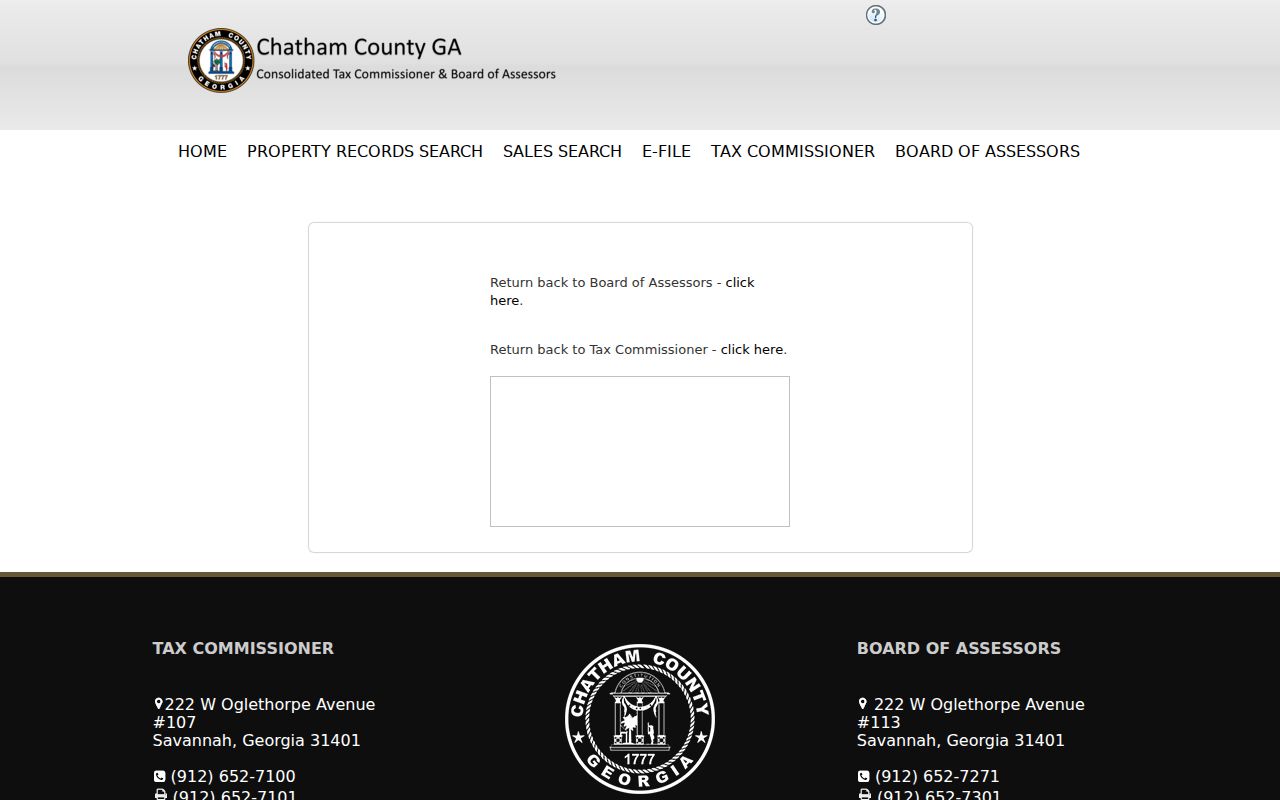
The portal pairs property records and tax functions, yet each result still demands a year and parcel match.
Chatham Homestead and Preference Records
The Board maintains current exemption and assessment forms covering homestead, agricultural, environmental, preferential, and appeal matters. Exemptions do not simply pass from seller to buyer. Eligibility, use, ownership, and filing rules must all be checked for the current tax year.
The annual notice can list exemptions, credits, preferential assessment, and estimated savings. Read those fields apart from the base values. A disputed omission belongs with the Board, not the deed office.
Agricultural or environmental treatment may reflect program rules. It may differ from the ordinary status of a nearby parcel. Save the application or approval year and note any covenant or use condition. A later sale or land-use change can carry effects that one year's tax bill does not reveal. Obtain the underlying preference record whenever it matters.
Chatham Tax Sales and Redemption
The official Tax Sale List sets the schedule for Chatham County tax sales. It also sets the starting inventory. The next sale appears as to be determined. Once a date is set, the page lays out first-Tuesday timing. It shows an opening bid built from taxes, penalties, and costs, plus same-day payment rules. Buyers should heed the caveat emptor warning. A sheriff's tax deed may stay defeasible, and redemption rights can survive the sale. The list alone confers no immediate possession or clear title.
Chatham County follows a redemption period of one year and one day. Statutory interest or costs apply under the applicable tax-deed route. A judicial in-rem sale can end differently. Never read the process off the parcel list. Pull the sale result, tax deed, notices, and any later court order. Then check them against the current tax roll.
Excess funds follow a separate claim track. It is open to owners of record at sale, heirs or beneficiaries, and lienholders. After five years the money moves to the Georgia Department of Revenue. It may need a Superior Court order. The Tax Commissioner does not recognize third-party recovery firms or powers of attorney.
Offline Chatham Property Tax Access
A portal outage never closes the record trail. The Board of Assessors sits at 222 West Oglethorpe Avenue, Suite 113, Savannah. The office is open weekdays from 8:00 a.m. to 5:00 p.m. Bring a PIN, situs address, owner name, and year to focus the request.
Route each ask to the right office. The Board handles notices, exemptions, and valuation files. The Tax Commissioner handles bills, payments, sales, and excess funds. For a recorded tax deed or lien, use the Superior Court Clerk and GSCCCA.
When a web record will not load, request the existing notice, parcel record, bill, payment entry, exemption filing, or appeal document by name. A Georgia Open Records Act request should stay narrow enough to locate. Protected fields may be redacted. The Act does not entitle anyone to a new valuation. It also covers no tax advice or custom report.
Challenge a Chatham County Assessment
The annual assessment notice starts the appeal clock. The Board of Equalization posts a 45-day filing window. The routes open after Board of Assessors review. Follow the instructions on the current notice, state your ground, and file within that period.
Solid evidence might be comparable sales, photos, repair estimates, an appraisal, income information, or other proof. A parcel record may list the wrong characteristics. Keep proof of filing and the final decision. A value dispute runs through the appeal process, not a deed correction.
Offline requests work best when you separate the annual notice from the bill and payment ledger. Name the year, PIN, situs address, and owner spelling. For a recorded lien or tax deed, add the book and page or instrument number. Then go through the Clerk. For an appeal file, ask for the filed appeal, evidence, Board response, hearing notice, and final decision. Do not ask staff to build a new report.
Value comparisons demand like records. Hold the assessment year constant. Note location, lot size, structure type, condition, exemption status, and flood or historic context. A nearby sale supports a case but does not fix the subject value by itself. When the parcel record carries the wrong improvement or land fact, document the claimed error. Use dated photographs, permits, plats, or other reliable deed and plat records.
Appeal window. File with the Chatham Board of Assessors within 45 days of the annual notice, following the current notice and appeal instructions.