
Start a Chatham County Property Search
The Chatham Tax Property Records Search accepts an address, an owner name, or a property ID, and that choice shapes everything after it. Addresses stumble over unit numbers and street abbreviations. Names bring co-owners, trusts, and business entities into the mix. So the PIN matters most. Once the property ID appears, often labeled a PIN, copy it exactly, spaces, hyphens, letters, and leading zeros included.
No single source settles anything. Chatham County property records work as cross-checks, never substitutes. The assessment roll names the owner tied to the tax parcel. GSCCCA indexes the recorded conveyances. SAGIS places the parcel on the map, yet none of these is a title opinion or a boundary survey.
When the address fails, go sideways. SAGIS can expose the PIN behind a mapped address. A recorded plat supplies the subdivision and lot, and a known deed citation opens the GSCCCA book/page search. Land with no ordinary street number may leave only the legal description and parcel shape as a dependable bridge, so keep every spelling and punctuation variant until the records converge on one parcel.
- Enter the situs, or physical, address in the Chatham property search and copy the PIN, owner field, and legal description.
- Open the PIN or address in SAGIS and confirm that the mapped shape and address identify the intended parcel.
- Search GSCCCA under the owner as grantee, then match the book/page, dates, and legal description.
- Check the assessment notice and Tax Commissioner bill for value, exemptions, balance, and the relevant tax year.
- Use the Clerk's counter, mailed request, or Garden City Records Center when an image or older volume is absent online.
Chatham County Property Record Keepers
Three offices split the main work in Chatham County. The Superior Court Clerk records deeds, security deeds, liens, and plats. The Board of Assessors sets fair market value, assessed value, and exemptions. The Tax Commissioner issues the bill, collects payments, and posts tax-sale material. Savannah Area GIS adds map context but replaces nothing. Knowing the split saves a trip. Assessment notices, exemptions, and appeals belong to the Board, while bills, payments, tax sales, and excess funds belong to the Tax Commissioner. Recorded instruments belong to the Clerk.
Before visiting, sharpen the request. Name the PIN, the record type, the parties, a date span, and any known book, page, or instrument number. A precise ask gets a precise record.
Office access goes beyond the website. Room 304 in the Clerk's quarters offers public computers. The Eisenhower Drive satellite handles copies and filing. Written deed, lien, or plat requests can travel by mail to the Clerk's post-office box. Older material lives at Garden City. Deed books, maps, plats, and microfilm equipment sit there, with appointments available for physical material. When the web omits an image, go in person.
Historical address work has its own route. Savannah city directories list the resident's name, a spouse notation, house number, street, occupation, and employer, and the street index adds a nearby cross street. Local runs begin in the nineteenth century. Later digital holdings reach 1959. But a directory names an occupant, not an owner. Pair it with a deed, a tax digest, a plat, a probate file, or an archival city deed before tying the person to title.
Superior Court Clerk, Real Estate
133 Montgomery Street, Room 304
Savannah, GA 31401
912-652-8971
Chatham Board of Assessors
222 West Oglethorpe Avenue, Suite 113
Savannah, GA 31401
912-652-7271
Search Chatham Deeds Through GSCCCA
The GSCCCA Real Estate Search runs in three modes: name, book/page, and a participating-county property search. The name screen is where most work happens. It accepts party type, instrument type, and county. A neighboring-county choice, search name, date range, results-per-page, and display settings are also included. Individuals go in as last name, first name. Entities should be tried with their exact suffix and common punctuation variants.
| Search control | Best use | Important limit |
|---|---|---|
| Search Name | Grantor or grantee trail | Same names require a parcel match |
| Book and Page | Retrieve a known citation | Both fields are required |
| Subdivision | Platted lots and phases | Subdivision is required in that mode |
| Date range | Narrow a transfer period | Check county coverage dates |
Coverage has limits worth knowing. The live name page advertises dates from 1990 to 2026, while GSCCCA's own description gives a more cautious baseline of at least 1999 and notes that older data is still being added. So a blank result proves nothing. Check the county good-through link before concluding that no document exists.
Match Chatham Parcels in SAGIS
Savannah Area GIS links each parcel polygon to its PIN and its surrounding map context. A parcel popup tells a lot. It lists the property address, PIN, and owner name. Calculated acreage, estimated zoning and flood zone, sale price, historic district, and local districts are included as well. Layer services add buildings, wetlands, hydrology, one-foot contours, municipalities, ZIP codes, and roads.
Map the parcel after the tax search, never instead of it. A postal city can differ from the municipality layer. The mapped owner is only a convenience field. Confirm it against the assessment roll and the latest deed. Parcel geometry is reference data, not a legal survey. For direct access, view the official SAGIS layer service.
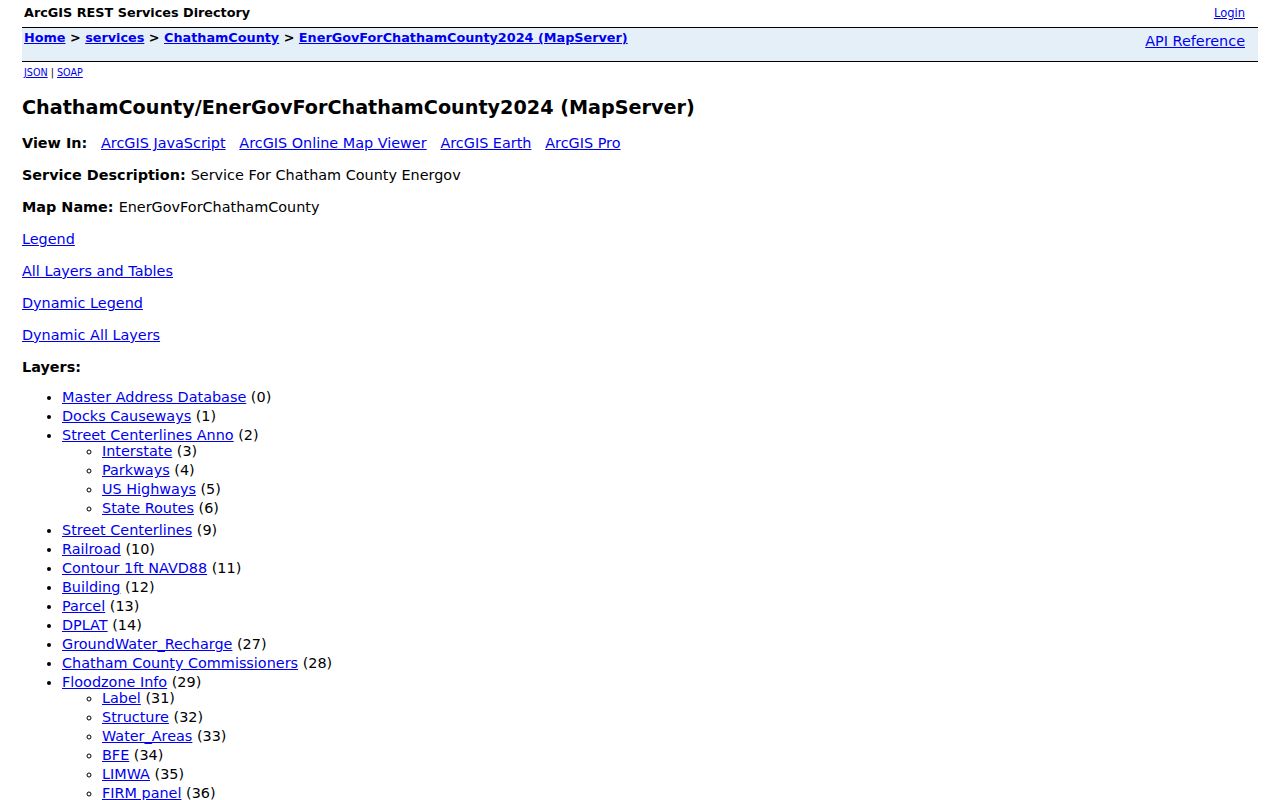
None of these layers proves title. A parcel can carry tax, zoning, flood, historic, and district facts, yet title still rests in the recorded deed.
Chatham County Property Record Types
The record trail runs in order: recorded ownership first, then the annual assessment, then the tax bill, the map, and the city project file. Each source captures a different event or official judgment. The table matches each record to its keeper.
| Record Type | What It Documents | Kept By | Access |
|---|---|---|---|
| Deeds | Transfers, parties, dates, legal descriptions | Superior Court Clerk | GSCCCA, counter, or mail |
| Security deeds and liens | Secured claims, releases, judgments | Superior Court Clerk | Index and records room |
| Assessment and tax | Fair market value, assessed value, exemptions, bills | Assessors and Tax Commissioner | Chatham Tax or office |
| Plats and parcels | Lot/block, mapped shape, subdivision | Clerk, SAGIS | Map viewer, plat index, older books |
| Building permits | Applications, reviews, inspections, project status | City department | City portal or records request |
A deed proves a transfer of title. An assessment instead sets value for the tax roll. Match Chatham County property records by PIN, legal description, and book and page, and remember that a security deed is an encumbrance rather than a later warranty deed.
The January 1 Chatham Owner Snapshot
Chatham's tax FAQ follows a simple date rule. The current bill tracks whoever owned the parcel on January 1. A sale later in the year can leave the former owner's name on that year's bill. The date rule explains the lag; it is not proof the conveyance failed.
The county publishes no fixed roll-refresh schedule. For a recent transfer, note the tax year first. Then compare the assessor's owner field against the deed's recording date, since the newest recorded deed reflects the freshest title event. That simple date check prevents a common false conflict.
Mailing addresses add their own confusion. One may point to an agent, a lender, a trust, or an owner living outside Chatham County. It shows where notices go, not who occupies the site. Keep the situs, the mailing destination, the January 1 bill owner, the current roll owner, and the latest deed grantee as separate facts. Their dates and roles usually explain an apparent mismatch.
Note: Mailing address, situs address, and owner name are separate fields and should remain separate in search notes.
Read Chatham Assessment and Tax Records
The Board of Assessors sets fair market value. It also sets taxable assessed value, reviews exemptions, and issues the annual notice. Georgia generally assesses property at 40 percent of fair market value. The Tax Commissioner applies the rates. The office produces the bill, collects payment, and handles delinquency.
Chatham's 2026 notice format is clearer. It displays fair market value, taxable assessed value, exemptions or credits, preferential assessment, and estimated tax savings. The Board points owners to the Annual Assessment Notice tab. A Value History reason of "APPEAL DECISION" may signal a 299C freeze. A recent purchase price can still differ from the new assessment. The county's HB581 and HB92 notice describes such circumstances.
Appeals begin with the annual notice. The Board of Equalization describes a 45-day window. Its routes run from Board review to BOE or other statutory options. Later court review may apply in some cases. Keep the notice and any sales or property-condition evidence.
Older Chatham Property Records Survive
Online coverage is only one layer of Chatham's long land history. The Clerk's Garden City Records Center sits at 4225 Augusta Road, Suite C. It holds older deed books, plats, maps, and microfilm. Public terminals and microfilm scanners or printers are available there. Older physical material requires an appointment.
The Georgia Archives Virtual Vault carries digitized Chatham deed books. The volumes run from March 1785 through July 1806. They name parties, price, signatures, and recording date. They also carry old legal descriptions tied to roads, creeks, plantations, or neighboring owners. Modern PINs did not exist. Research must connect descriptions forward through deeds and plats.
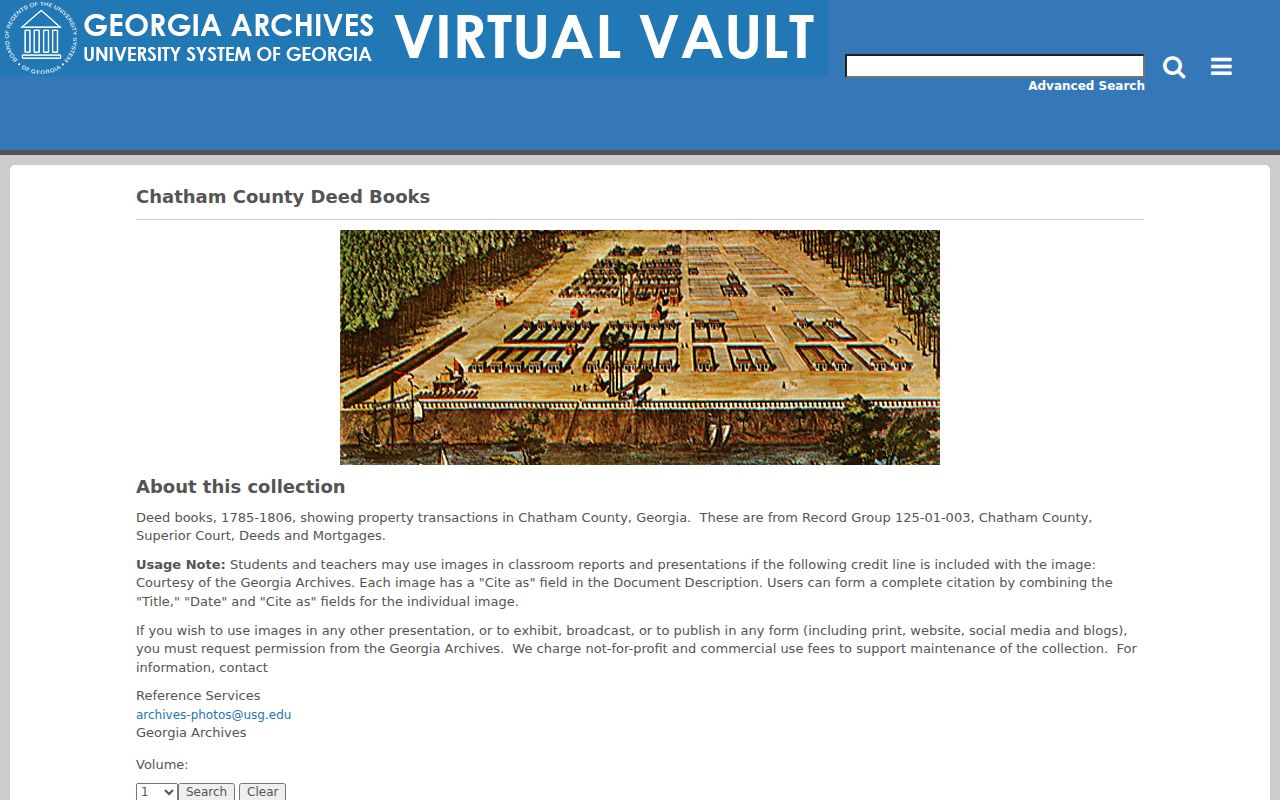
The Virtual Vault is not a modern address search. It opens original deed volume images and transcriptions instead. Savannah city directories and ward notebooks can then bridge an old house number or resident to a later parcel.
City Records Add Chatham Property Context
Savannah, Pooler, and Port Wentworth keep no separate deed registry. Their permit and planning systems add zoning, project, and inspection history to the county's title and tax files. Savannah eTRAC offers public address and project searches. Pooler's CivicGov channel centers on applications and inspections. Online submission there requires an account. Port Wentworth uses Development Services forms, in person or by download, and publishes no public results index.
Savannah's search accepts address, project name, permit type, work class, and related criteria. Its permit tracker has a radius tool. The tool shows nearby projects, not an owner list. Port Wentworth's forms cover building, land development, subdivision, and zoning verification; with no public result screen, request the existing city file rather than assuming none was created.
City boundaries and postal names diverge. A Savannah mailing label does not establish city jurisdiction. Confirm the municipality in SAGIS before choosing a permit source.
Chatham Tax Sales Need Extra Checks
The Tax Commissioner Tax Sale List posts scheduled sales. It is the official starting point. The schedule reads to be determined. The office warns caveat emptor. A sheriff's tax deed can carry defeasible title, redemption rights may remain, and a list entry alone proves neither clear nor immediate possession.
Once a sale is set, Chatham County describes a first-Tuesday auction. The opening bid covers taxes, penalties, and costs. Details can change, so the live notice controls. An auction does not answer everything. It cannot say whether redemption has ended, whether another lien survives, or whether a judicial in-rem process changed the title, so follow the sale to the recorded deed and later court or redemption records.
Monthly sales-result links cover 2023 through 2026. They show prior activity. Excess funds are a separate claim process open to an owner at sale, an heir or beneficiary, or a lienholder. The office reviews documentation and warns that it does not recognize third-party recovery firms or powers of attorney. Match every entry back to the parcel, then check the tax record, the deed, and the lien trail.
Chatham Property Search Terms Defined
Chatham County files lean on short labels with real legal weight behind them. Know the difference before you jump between a deed index, a tax roll, and a GIS map.
- Grantor and grantee
- The party conveying an interest and the party receiving it in a recorded instrument.
- PIN or property ID
- The county tax and mapping key; it is not the deed's full legal description.
- Assessed value
- The taxable assessment derived under Georgia's valuation rules, distinct from market value and sale price.
- Plat
- A recorded map of lots or land divisions; the current GIS view is not itself the recorded plat.
A clear grasp of these terms makes any Chatham County property records search easier to verify. Keep the source, year, and citation beside each fact you save.
Limits on Chatham County Property Records
Chatham County public records can tell you plenty. They show the indexed owner of record, recorded deeds, assessed values, mapped parcels, tax bills, permits, and recorded encumbrances. What they cannot do is prove who actually occupies a building. They also cannot guarantee a complete chain of title, settle a surveyed boundary, or replace a private appraisal. Court images are sometimes withheld online, protected identifiers get redacted, and Safe at Home or VoteSafe can shield a qualifying address without erasing the deed or changing who holds title.
The Georgia Open Records Act gives you a route to request existing records, though exemptions and redactions still apply. It does not force an office to answer legal questions or invent a record that was never made. If online access comes up short, file a focused request with the parcel PIN, names, a date span, and the document type you want.
Lawful use. Chatham County property records support due diligence, boundary research, estate work, and civic review. A search is not a title search, and owner data must never be used to stalk, harass, or harm anyone.